



What Are Neoantigens?
Neoantigens are newly arisen antigens that appear during the development and progression of cancer cells. Cancer cells emerge as a result of genetic mutations in normal cells. The abnormal proteins generated by these mutations can be recognized by the immune system as foreign, sometimes triggering an immune response that targets and attacks the cancer cells. Neoantigens are unique not only to the tumor site but also to each individual patient. To expand the possibilities of cancer treatment, we are working on the development of immunotherapies and cancer vaccines that specifically target neoantigens.
Cancer Antigens : Neoantigens
Cancer Antigens
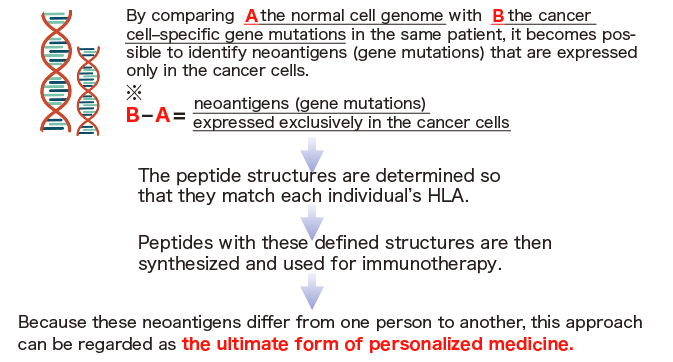
Neoantigens are newly formed antigens that arise from genetic mutations occurring as normal cells transform into cancer cells, and they are expressed exclusively on cancer cells.
Because these neoantigens differ from one individual to another, they can be regarded as the ultimate form of personalized medicine.
Neoantigens
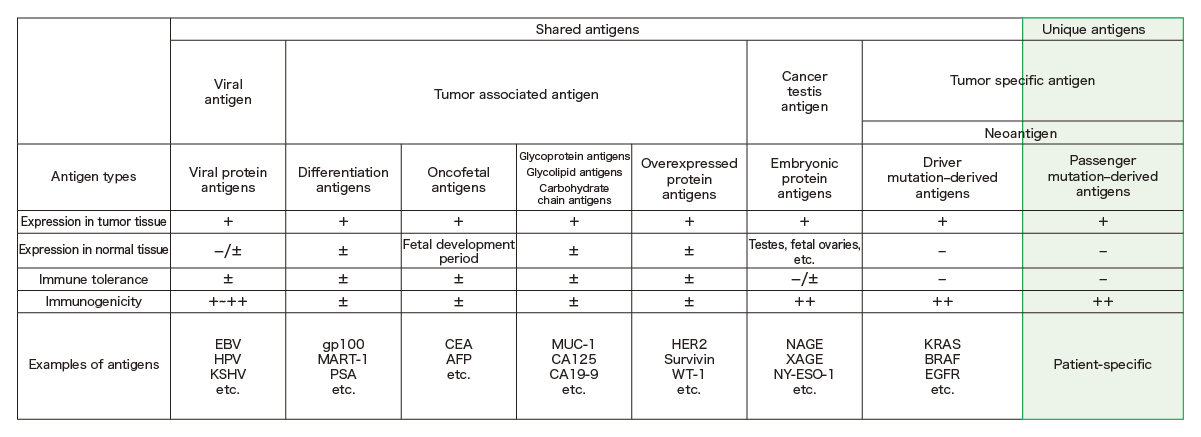
Cancer cells express proteins that are not present in normal cells. Tumor-specific T cells can recognize these subtle differences and distinguish cancer cells from normal cells, enabling them to attack the cancer cells.
For peptides derived from proteins that exist in normal cells, those normal cells are spared from attack by the
immune system. Consequently, for antigens that are expressed not only on cancer cells but also on normal
tissues—such as tumor-associated antigens—it is often difficult to induce a strong immune response. For
example, cancer‒testis antigens are expressed in normal tissues only in sites such as the testes, which are
normally segregated from the immune system. By contrast, proteins generated through amino acid substitutions
caused by tumor-specific somatic gene mutations constitute tumor-specific antigens known as
neoantigens. Because they escape central immune tolerance, they are expected to elicit robust immune
responses.
Antigens can be classified into shared antigens, which are observed in multiple patients, and unique antigens, which are specific to each individual patient. Owing to their broad applicability, intensive efforts have so far focused on developing cancer vaccines targeting shared antigens. Unique antigens have attracted little attention as targets for molecularly targeted therapies or immunotherapies, because they are difficult to identify using conventional methods and, even when identified, are applicable only to a single patient. However, with the advent of next-generation sequencing (NGS) in recent years, it has become possible to comprehensively analyze the somatic mutations present in each patient, making it feasible to search for unique antigens and to pursue truly personalized medicine. As a result, cancer vaccine therapies targeting neoantigens, which are such patient-specific antigens, are now drawing increasing attention.
Neoantigen Dendritic Cell Therapy
Neoantigen + Dendritic Cell Vaccine Therapy
What is “neoantigen + dendritic cell vaccine therapy,” a form of cancer immunotherapy?
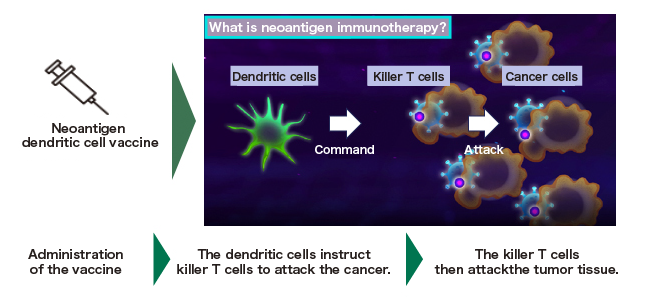
This therapy works by having dendritic cells, which serve as the command center of the immune system, recognize neoantigens that act as markers of cancer cells and by inducing a strong immune response to eliminate those cancer cells.
Challenges
1. A key issue in identifying neoantigens is whether tumor tissue can be obtained through surgery or biopsy.
2. In addition to surgery, patients must undergo blood component collection (apheresis) to obtain cells for dendritic cell preparation, which places a substantial burden on them.
CTC Neoantigen Dendritic Cell Therapy
Our proprietary “CTC + neoantigen + dendritic cell vaccine therapy”
We are the first in the world to enable the identification of neoantigens without requiring surgery. Traditionally, neoantigen identification depended on the surgical removal of tumor tissue, but our approach makes it possible to identify neoantigens without using tumor tissue.
* PCT international patent application pending.
As a result, it has become possible to offer a treatment that places less burden on patients.
Our CTC neoantigen dendritic cell therapy
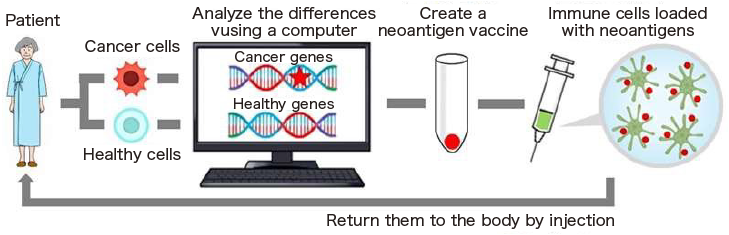
Focusing on cancer cells that detach from the primary tumor, travel through the bloodstream, and colonize other sites to cause metastasis, we have succeeded in collecting large numbers of circulating tumor cells (CTCs), even though the amount of CTCs in the blood is extremely low and their detection has been difficult. This has enabled the identification of neoantigens without the need for surgery.